

Impact of Er,Cr:YSGG laser and bonding protocols on enamel surface integrity and bracket bonding strength: an in vitro study
All claims expressed in this article are solely those of the authors and do not necessarily represent those of their affiliated organizations, or those of the publisher, the editors and the reviewers. Any product that may be evaluated in this article or claim that may be made by its manufacturer is not guaranteed or endorsed by the publisher.
Authors
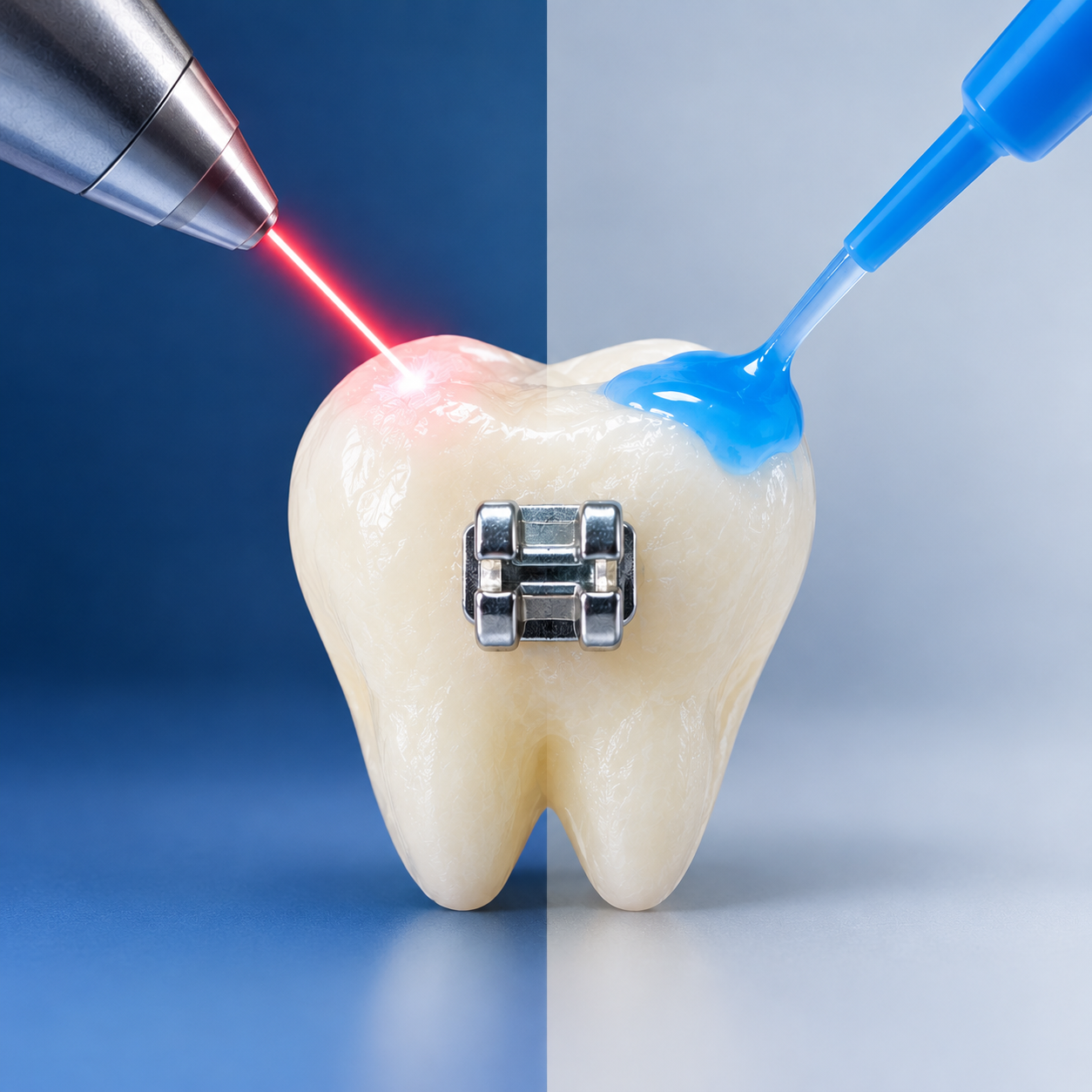
Adequate enamel conditioning is vital for reliable bracket bonding. Laser-assisted alternatives to conventional acid etching exist, but their impact on shear bond strength (SBS) remains highly controversial. This study aimed to evaluate the effect of Er,Cr:YSGG laser enamel conditioning on the SBS of orthodontic brackets bonded using different composite materials in the presence or absence of a bonding agent. Thirty-six extracted human premolars and molars were randomly allocated into four groups (n=9). Group A received Er,Cr:YSGG laser conditioning followed by bonding with 3M Universal Bonding Agent (3M ESPE, St. Paul, MN, USA) and 3M composite (3M ESPE, St. Paul, MN, USA). Group B (control) received conventional phosphoric acid etching followed by bonding with 3M Universal Bonding Agent and 3M composite. Group C received Er,Cr:YSGG laser conditioning followed by bonding with Nova composite (Imicryl, Konya, Turkey) without a bonding agent, while Group D received conventional phosphoric acid etching followed by bonding with Nova composite without a bonding agent. SBS testing was performed using a universal testing machine, and failure patterns were qualitatively assessed using the Adhesive Remnant Index (ARI). Artificial intelligence technology of IBM SPSS Statistics software (IBM Corp., Armonk, NY, USA) was used for the statistical analysis. The mean SBS values were 13.06±4.20 MPa, 15.29±9.52 MPa, 13.20±8.04 MPa, and 11.41±6.22 MPa for Groups A, B, C, and D, respectively. One-way analysis of variance (ANOVA) revealed no statistically significant difference among the four groups (F(3,32)=0.428, p=0.734). Although Group B demonstrated the highest mean SBS and Group D the lowest, substantial overlap in standard deviation (SD) values was observed among all groups. The qualitative ARI assessment indicated that the predominant failure mode corresponded to score 2. No significant difference in orthodontic bracket SBS was observed between Er,Cr:YSGG laser conditioning and conventional phosphoric acid etching.
Downloads
Citations




Ethics Approval
This study was conducted following approval from the Research Ethics Committee of Ajman University for Science and Technology, United Arab Emirates (Approval No. D-F-H-26-05-20). Written consent to participate was obtained from all study participants.CRediT authorship contribution
Ahmed El Gamal: conceptualization, design, data acquisition; Maria Micheal Morise Mahrous, Haima Aamir Nadhim Alkhafaji, Rawnaq Atheer Aljuboori, Raghad Fahmi: data collection, analysis, and interpretation, writing – original draft; Mohammed Naji, Majd Naji: revision. All authors have read and approved the final version of the manuscript and agreed to be accountable for all aspects of the work.
Supporting Agencies
This study received no specific funding.Data Availability Statement
The research dataset is not publicly available.
How to Cite

This work is licensed under a Creative Commons Attribution-NonCommercial 4.0 International License.